Settlers in Jamestown founded Williamsburg in 1632 as Middle Plantation. In 1699 the capital of the Virginia Colony moved to Middle Plantation, now named Williamsburg in honor of King William III, because it was healthier and more defensible than low-lying Jamestown. It remained the capital until 1789, by which time the population centers were farther west and British forces threatened the Tidewater area.
After the capital moved, the city's fortunes rose and fell with time and war. The constants were the College of William and Mary, established in 1693, the second-oldest institution of higher education in the US (Harvard dates from 1638), the county government, and the Eastern State Mental Hospital. In the 1920s Reverend Dr. William Goodwin assumed the task of restoring Williamsburg to its colonial glory. He enlisted the enthusiasm and deep pockets of John D. Rockefeller, Jr., and began to buy up the land that became the core of the restoration. The story of the Colonial Williamsburg project is more than I can summarize, but many buildings were restored and many were reconstructed based on historical records and archeological research. Research and restoration are ongoing.
The Governor's Palace and the colonial Capitol have their own pages. This page covers the other things we saw.
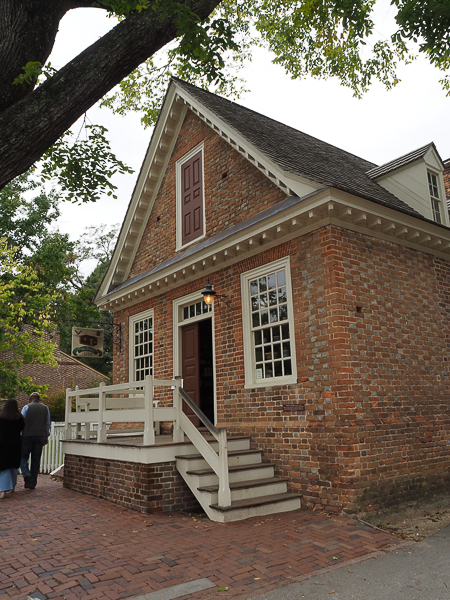
Very many buildings are reconstructions, but this one is (more-or-less) original. The Prentis Store, dating from 1740, is the oldest commercial building in town. That said, it was extensively modified and has now been returned to its original layout, as can best be determined.
Jim tells a story of the "original colonial ax." It has had three new heads and five new handles, but has been in continuous use since the 18th century. Williamsburg is similar.
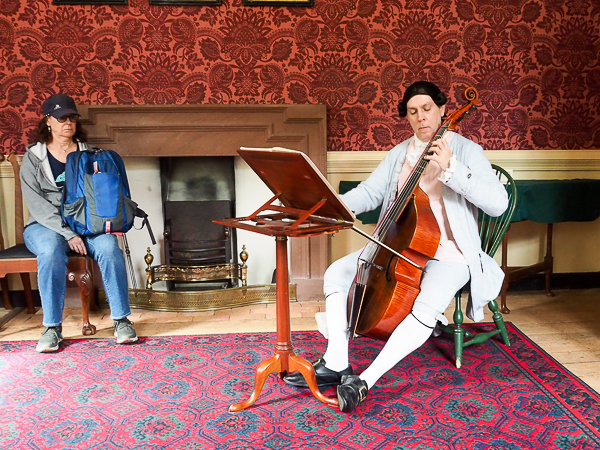
Being musicians, we were interested in visiting the Wythe House where musical demonstrations were scheduled.
George Washington used the house, built in the 1750s, as his headquarters during the Yorktown campaign. The front parlor, where the demonstrations were held, has been restored in stages -- most recently in the mid 1990s when period wallpaper was added.
The musician is Brady Lanier, a professor at William & Mary. He is playing a modern 7-string viola da gamba.
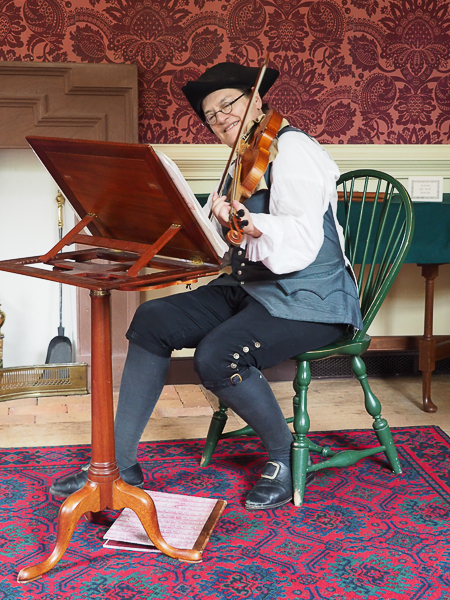
After the viol demonstration, we enjoyed a violin demonstration. I didn't get her name or enough information to look her up, but she was an enjoyable player (and seemed to enjoy herself much more than Dr. Lanier, who was very, very serious).
She is dressed as a man because women in the 18th century typically did not play violins. (They did play viols such as the one above.) This stereotype has been challenged in recent scholarship.
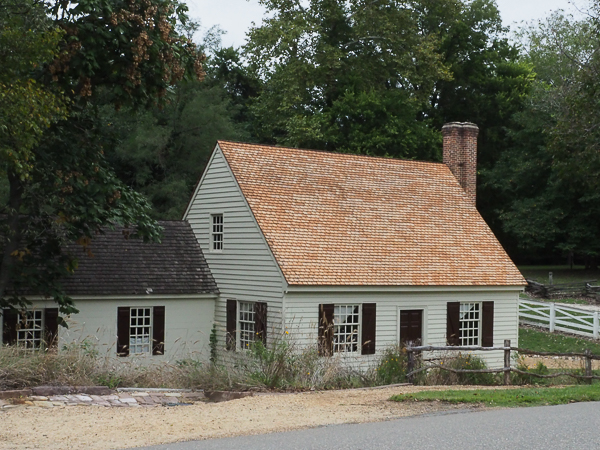
After the musical performances, we made our way to the Anthony Hay Cabinet Shop, where artisans made furniture and also harpsichords.
There was a spinet in progress, but the artisans were not communicative, so I can't tell you much about it. There was one on display in the shop that Barbara played a bit.
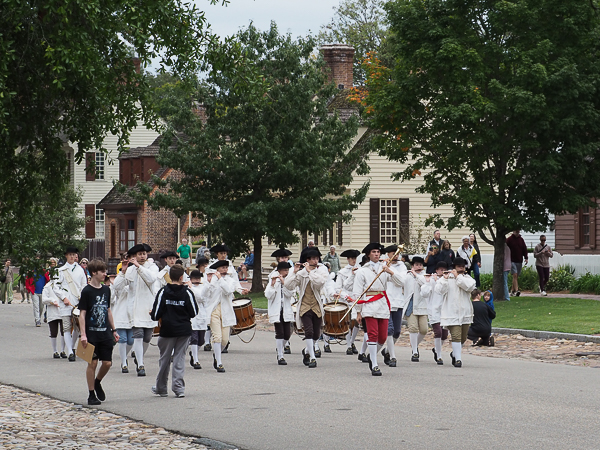
After visiting the cabinetmaker, we headed for lunch. There are a wide variety of eateries in Colonial Williamsburg, and we were looking for something simple. We got sandwiches at Chowning's Garden Bar and sat at a picnic table out back.
While there we heard music and ran out to catch the march of the fifes and drums.
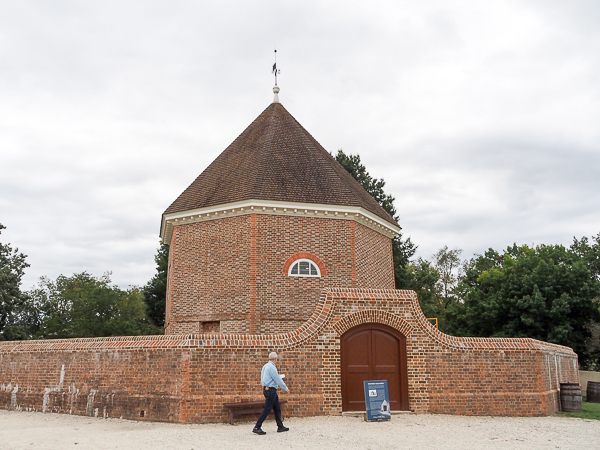
In 1715 Royal Governor Spotswood designed this octagonal structure to hold the additional munitions sent to the colony by Queen Anne. Increased security needs during the French and Indian war prompted the construction of the surrounding wall and a nearby guardhouse.
In 1775, as revolutionary sentiment rose, Governor Lord Dunmore had the munitions removed to British warships in the York River, but public outcry demanded their return.
After the capital moved to Richmond in 1780, the building had many uses: a market house, a place of worship, a Confederate arsenal, and a livery stable. By the time the Association for the Preservation of Virginia Antiquities acquired it in 1889, it was ruinous. Colonial Williamsburg first restored it in the 1930s, and it is still being updated today based on new archeological research.
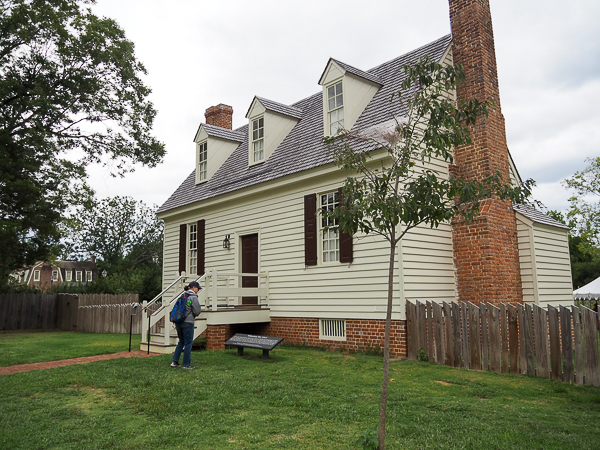
We were headed for the Eastern State hospital when an enthusiastic Black docent hailed us from this installation. It is the original Williamsburg Bray School. Dr. Thomas Bray formed The Associates of Dr. Bray dedicated to the religious education of African slaves. This was before the widespread prohibition of literacy in the enslaved population.
The docent said that the Bible used in the school had the book of Exodus removed!
The original school building was moved to this location from the campus of William and Mary to prevent its being demolished for new construction.
We didn't make it to the hospital.
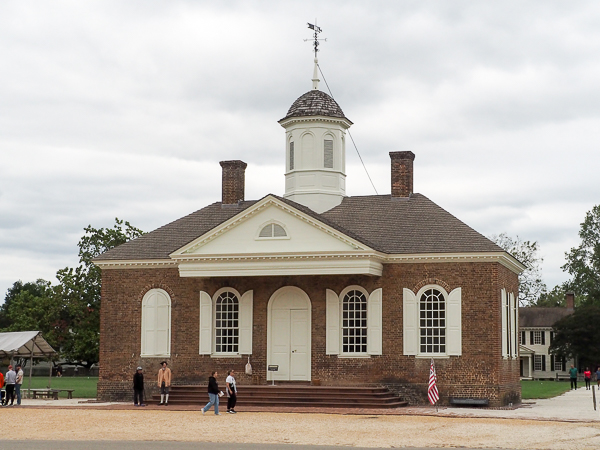
The 1771 courthouse served until 1931 in spite of vandalism during the Civil War and a fire in 1911. The city and county donated the building to Colonial Williamsburg and the exterior was restored. It was used as a museum for many years and restored to an 18th century courthouse format in 1991.
We had hoped to attend the Order in the Court presentation, but our timing was off and we needed to get to our jam session.
Click your "back" button to return to the previous page or click for our picture album.