We started our visit to Williamsburg at the Governor's Palace. Since we had plans for our jam session later in the afternoon, we arrived early and missed the crowds for this tour. The original building was begun in 1705 and completed in 1722. It burned in 1781 and was not rebuilt. The current edifice is a new construction on the original foundations. Its design is based on period documentation including a floor plan drawn by Thomas Jefferson, who lived there for a while as governor of Virginia before the capital moved to Richmond. Exterior details were supplied by the Bodleian Plate, which depicted several of the colonial landmarks in the early 18th century.
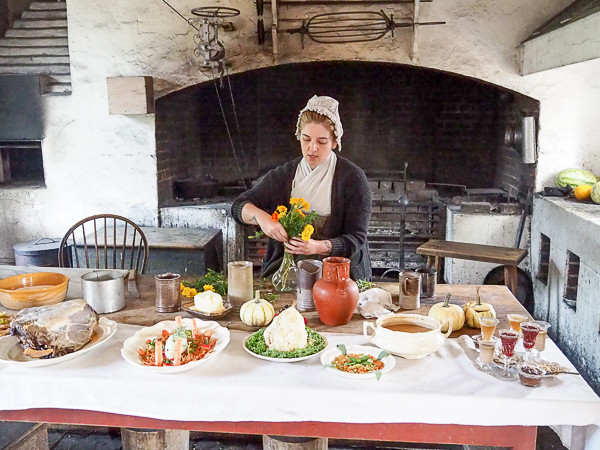
While we waited for the tour to begin, I wandered over to the kitchen. This interpreter had several demonstration dishes prepared. All of the dishes are created in this kitchen, but they are not necessarily fresh every day. She told me that there was a device upstairs in the kitchen building, "remarkably like" a refrigerator, used to store foods until they started looking tired.
After our tour this area was jammed so I was glad to have seen it early.
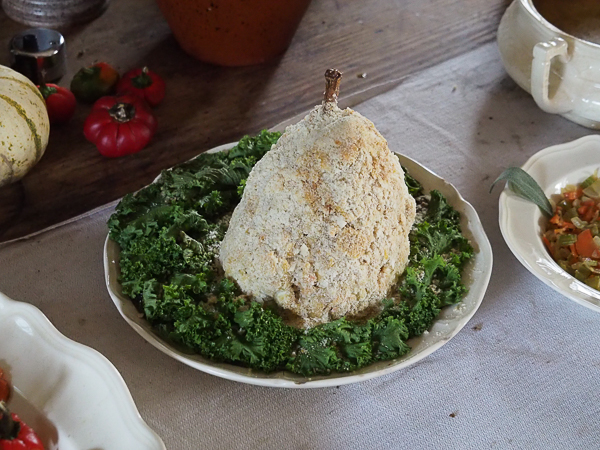
This dish was really stuffed pigeon. The stem of the "pear" is actually the pigeon's leg bone.
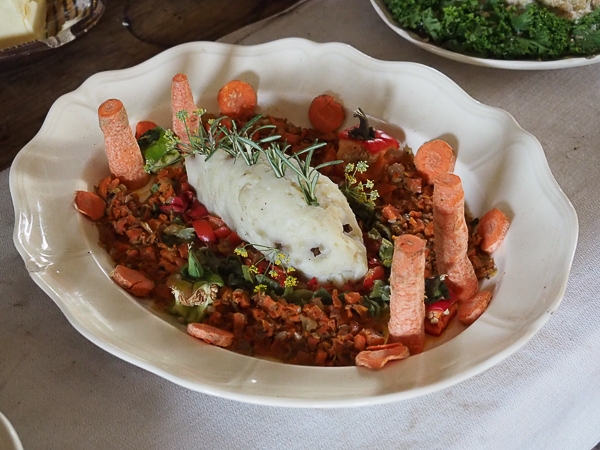
Mashed potatoes and fixings resemble a fish. The banquet food at the Governor's Palace was not just supposed to taste good, it was supposed to appeal to the eye as well.
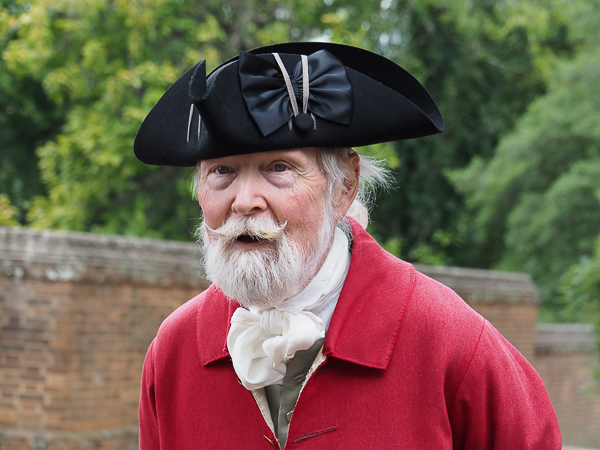
Our guide for the Governor's Palace was a delight. Actually all of the guides were delightful -- knowledgeable and enthusiastic about their work.
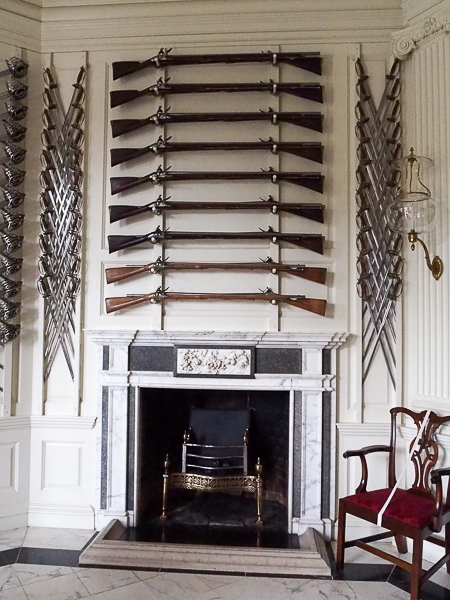
The first room we visited was the reception hall. Petitioners to the governor would be shown into this room to wait. Most of them would never get past this room.
While waiting, they could contemplate the show of strength as shown by the weaponry displayed on all the walls. This is just a small sample. Among other things, the ruling powers hoped to discourage bad behavior against the government.
I don't know if the governor had a stash of powder here, or if he relied on the supplies in the magazine. If the latter, it is understandable why he would order it removed for safe-keeping when revolution began to be discussed.
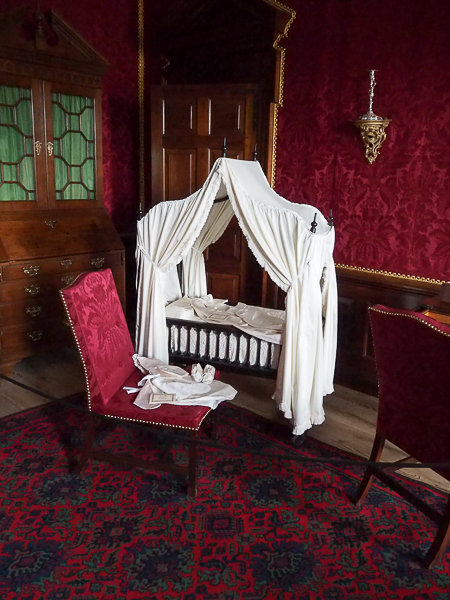
An upstairs reception room was used for more intimate gatherings. I was puzzled by the cradle set up in the reception area. The guide explained that it would have been used to present a new baby to society.
I've not been able to find any references to verify this, but I can't think of any other reason to have a cradle here. None of the bedrooms had one.
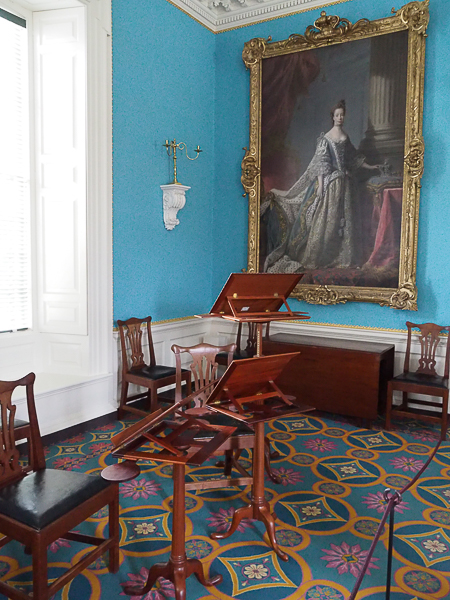
The main hall was a place for public receptions, musical performances, and dances. I loved the (reproduction) music stands. The portrait is of Queen Charlotte, King George III's wife.
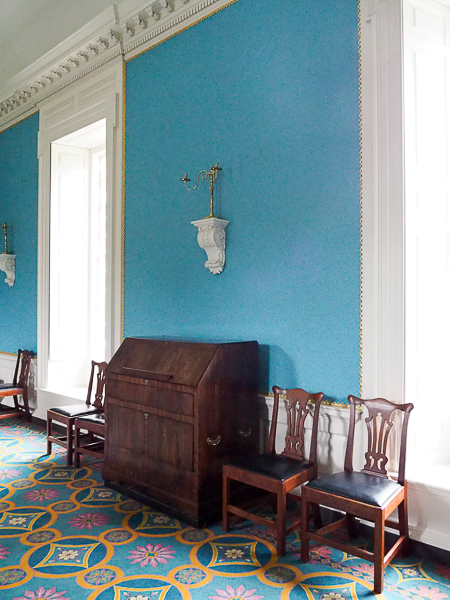
This unassuming cabinet is an organ! Specifically an Adcock & Pether bureau organ. Although it is not original to the palace, it is of the right period.
Colonial Williamsburg has an extensive collection of musical instruments.
Our friend David once had a side gig performing in various Williamsburg venues as a strolling troubadore. Their practice was to play only 18th century music that might have been heard in colonial times -- no matter how many times listeners requested Ashokan Farewell.
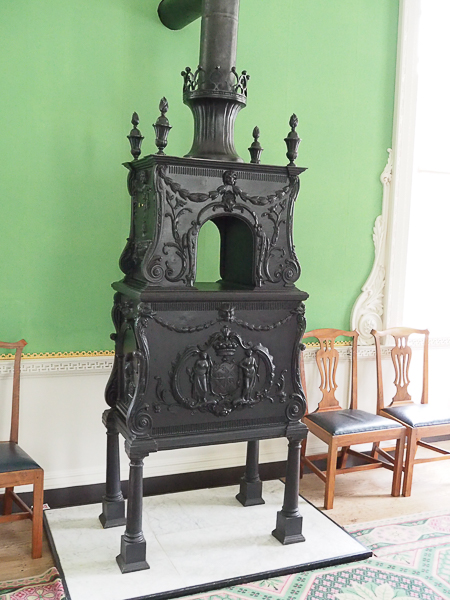
There are several reproduction heating machines in Williamsburg. They are from a design by Abraham Buzaglo. There were two in the Governor's Palace and one in the Capitol.
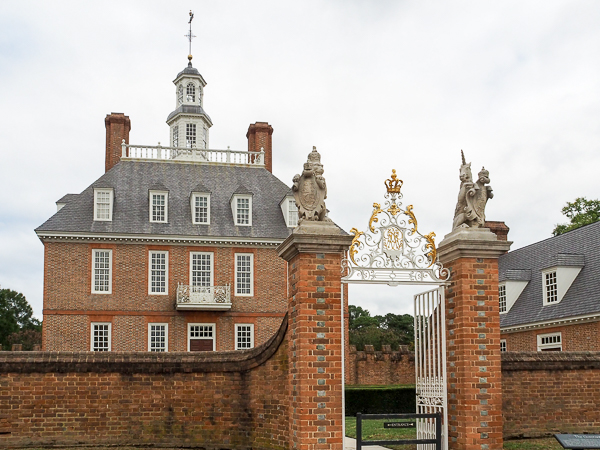
I suppose it is in keeping with Georgian formality and symmetry that most pictures of the palace are directly in front of it, but I favor asymmetry. This angle shows up the crest and the lion (England) and unicorn (Scotland) on the gateposts.
Click your "back" button to return to the previous page or click for our picture album.