On the third day we were back at Lake Lenape for a session with Rick Koval, a local naturalist. His knowledge and enthusiasm were impressive. This was billed as a "walk" rather than a "hike," but it covered some territory. Nevertheless, it was a lot less strenuous than the other outings and was mostly on wider and gentler paths or fire roads.
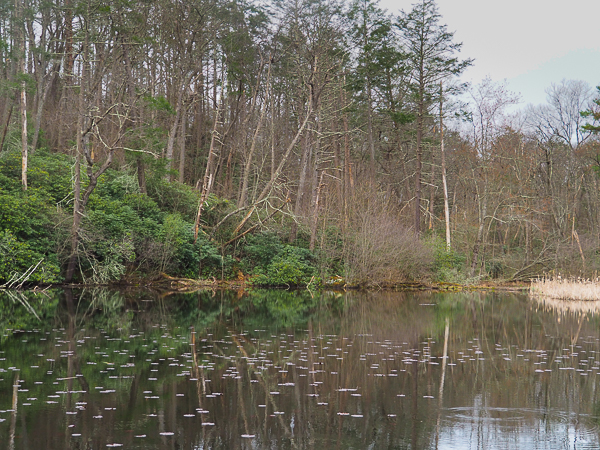
The shore of the lake was covered with rhododendrons. They must be spectacular in bloom. Rick said that by mid-summer the water lilies, still small at this point, would completely cover the surface of the pond, er, lake.
We had some discussion about whether this is really a "lake" or a pond. As I recall, there was once a resort here with the lake on its property. At that time, the water feature was managed intensively and was rather larger, so perhaps it would have seemed more like a lake. Rick showed us some postcards that pictured canoeing on the lake. Besides, "Pond Lenape" doesn't sound very impressive.
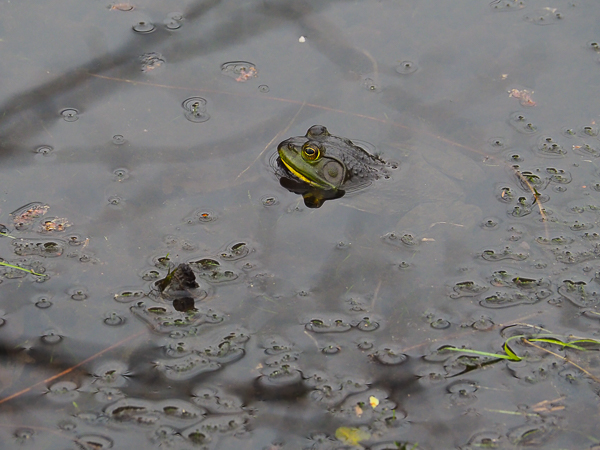
Rick pointed out this male bullfrog hanging around in the shallow water and then proceeded to capture it for further discussion.
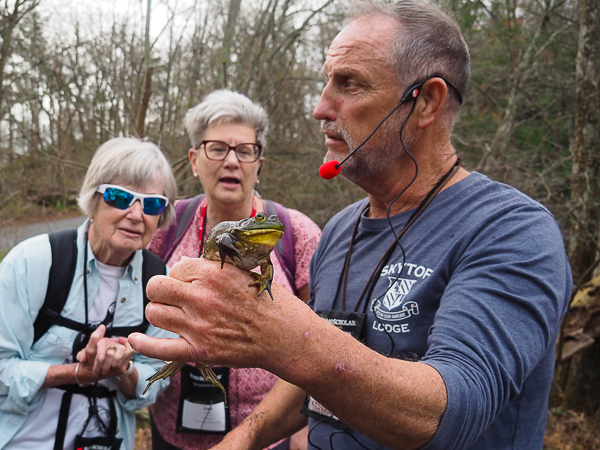
He described the way to tell the difference between the bullfrog and the similar green frog -- the bullfrog has a smooth back, the green frog has a ridged back.
The male bullfrog in breeding season also sports a fetching yellow chin, easily seen here. Another way to tell the difference between the male and the female is the relative size of the externally visible ear drum and the eyes. In the male, the ear drum is larger than the eyes.
As with the rest of the animal "exhibits," Rick was careful to return it to the exact place where it was found -- with one exception.
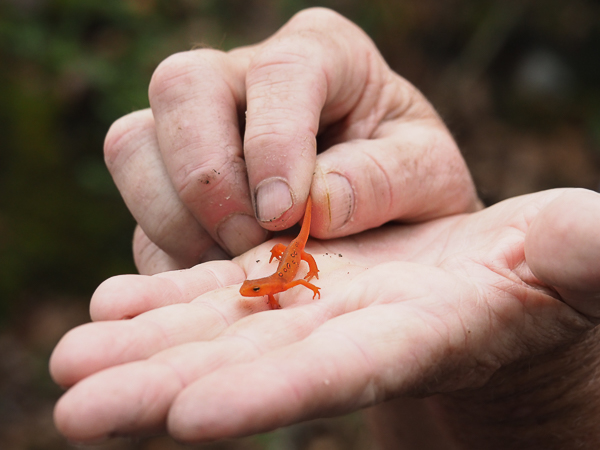
Along the trail as we climbed up from the lake, we came upon this brightly colored critter. It is a young sub-adult, or eft, stage of the red-spotted newt. These animals have three life-stages: an aquatic larval stage, a terrestrial sub-adult stage, and an aquatic adult stage.
This was the exception to returning the animal to the place where it was found. When we first saw it, it was crossing the trail, so Rick put it down on the side of the trail it was going towards. He said we should also do this with turtles we find crossing the road. Otherwise they will just cross the trail or road again.
The bright coloration is a warning to predators: don't eat me, I'm poisonous.
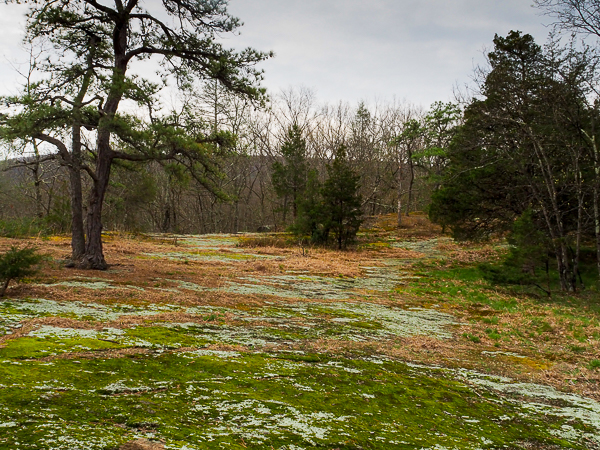
As we reached the high point of our hike on this rocky bald, we encountered a moss and lichen "garden." This location has examples of all three types of lichens: "foliose," "fruticose," and "crustose." Foliose lichens often resemble lettuce and are often found on trees. Crustose lichens form a crust and may even look like paint on a rock. Fruticose take many different forms.
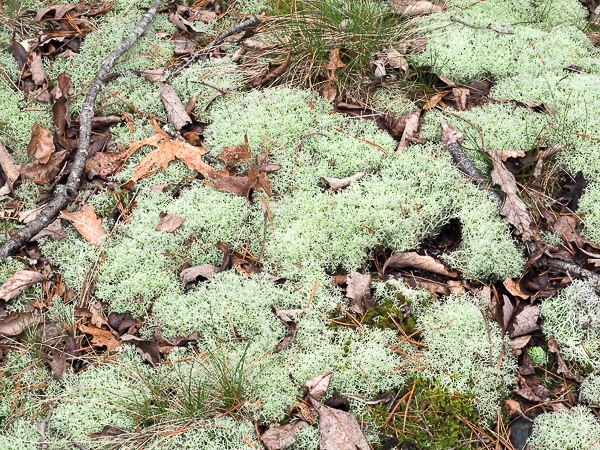
This is an example of a fruticose lichen -- it looks like a collection of tiny shrubs. It's also called reindeer lichen.
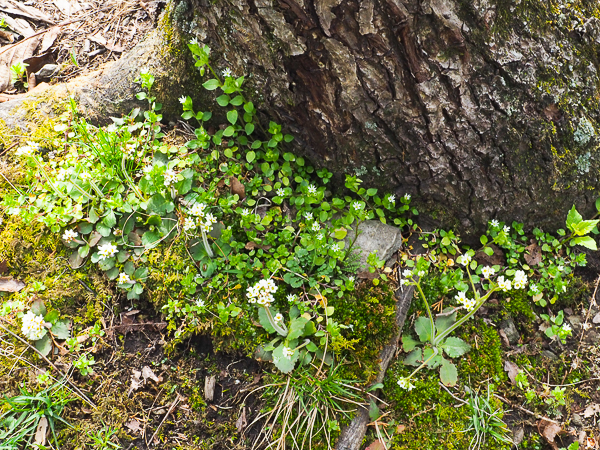
This tiny garden of saxifrage, chickweed, and mosses at the base of a tress appealed to me.
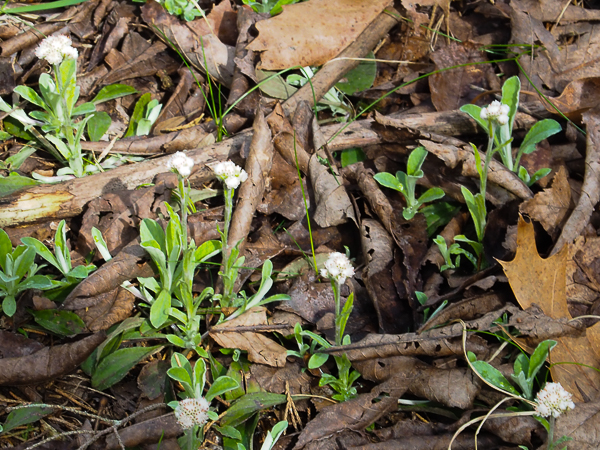
I'm pretty sure these are pussytoes. It would have been awkward to carry a notebook, but my memory gets fuzzy -- just like pussy toes.
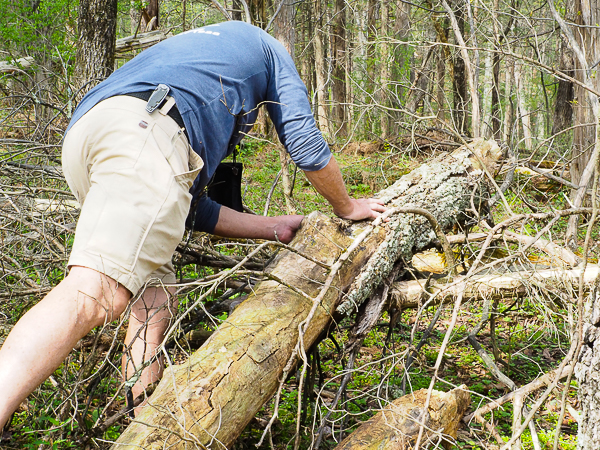
There was a tangle of snakes on and around this log. Rick is giving his all to snare one to show us.
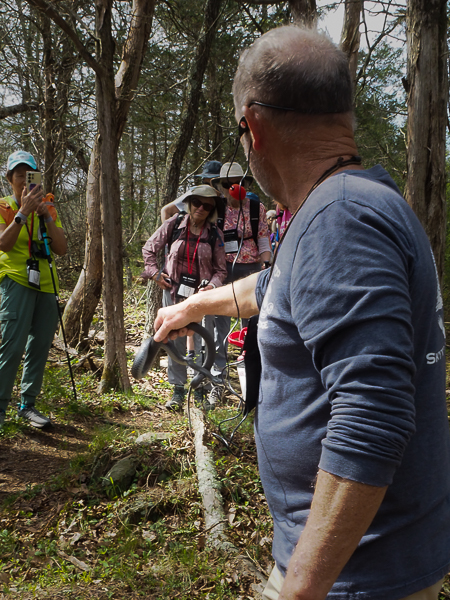
Success!
The snakes were black racers. Although they are not venomous, Rick said that their saliva contains a mild anticoagulant. He also said that a disturbed racer would certainly bite. This one did -- twice.
Funny how no one seems to be interested in getting a close-up photo.

The round-lobed liverleaf, or hepatica, got its name because the three-lobed leaf was supposed to resemble the liver. The plant was once used to treat liver-related disorders.
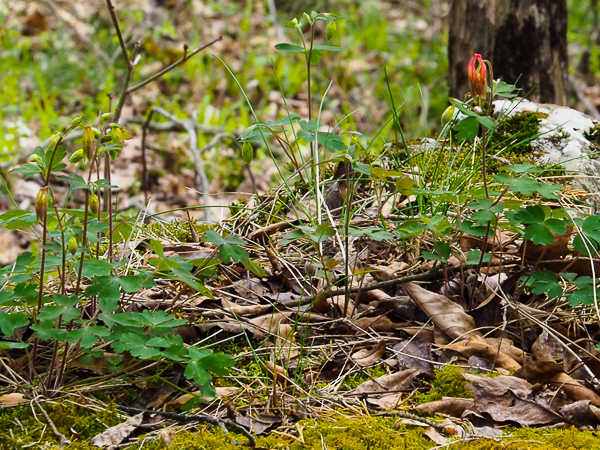
We found a clump of columbines, but only one was blooming this early. When I left home, the columbines in my garden were just about to bloom. By the time I returned, they were in full bloom.
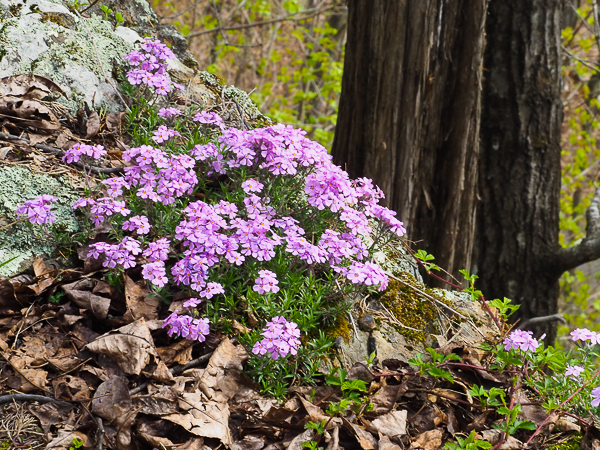 Moss phlox
is often seen in gardens. It also comes in white and pink. I've tried
multiple times to grow it in a variety of habitats, but without success.
Moss phlox
is often seen in gardens. It also comes in white and pink. I've tried
multiple times to grow it in a variety of habitats, but without success.
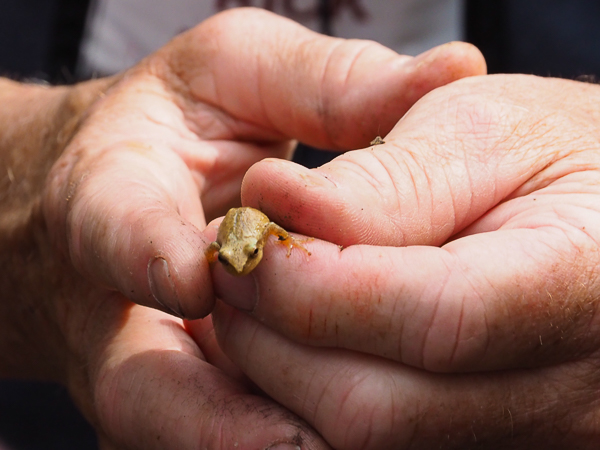
Rick continued to demonstrate his capturing skills by nabbing a tiny spring peeper frog. This is a female.
One of the things that I miss in our retirement community is the spring frog chorus. The peepers lay their eggs in water and there is no creek near our cottage.
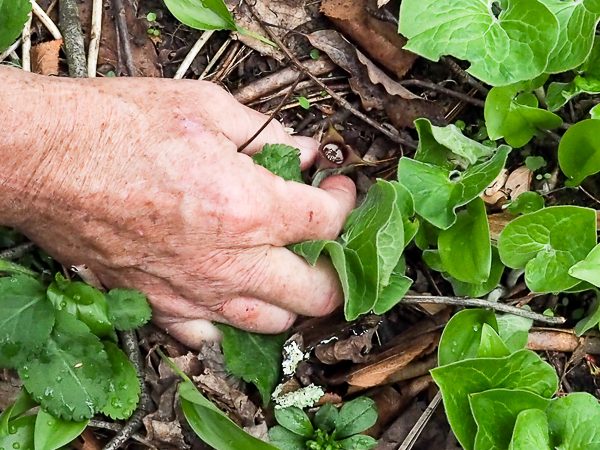
Rick was excited to find wild ginger in bloom. The small flower is at the base of the leaves and not visible from above. It lies along the ground, so Rick had to pick it up to show it off to us.
The plant has antibiotic properties and has been used as a poultice to treat wounds.
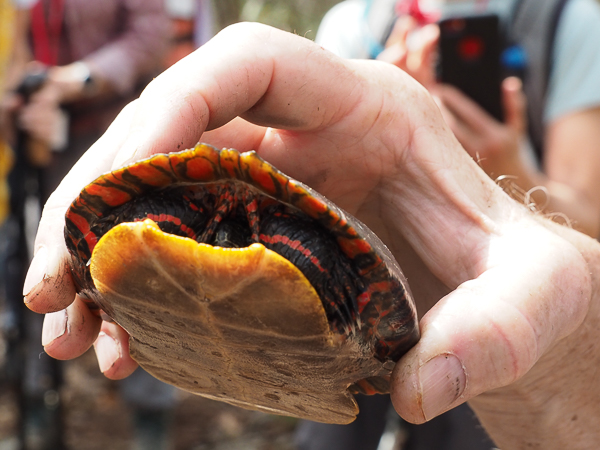
Rick found this male painted turtle to show us. He has withdrawn so far into his shell, that you can only see the tip of his nose. Better pictures are at the link.
This evening we had a presentation by Susan Downing, the director of a local wildlife rehabilitation center, The Wilderz at Pocono Wildlife. She had many interesting facts about turtles. One was that they are true homebodies. If they are moved, they will travel miles attempting to return to their territory, so don't move turtles except to help them cross a road. She also said that a turtle that has survived being run over by a car can often be saved if taken to a rehabilitator soon enough.
Susan brought many other animal "ambassadors" to introduce their work: Sorin, the barn owl, Vena the kestrel, Callie, the striped skunk and her opossum buddy with whom she is bonded and inseparable (!), Minimus, the tiny saw-whet owl, and others. They strive to rehabilitate animals to be returned to the wild, but some can no longer survive a life in freedom so become ambassadors.
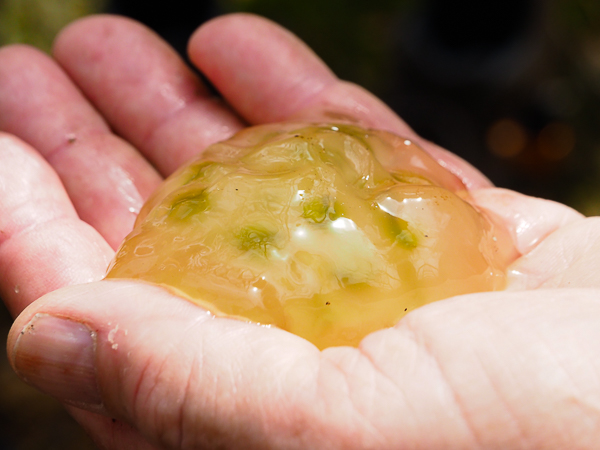
Rick made another foray into the pond to retrieve this egg mass, which I believe belonged to the red-spotted newt (memory like a sieve). The green color comes from beneficial algae that accumulate around the individual eggs.
After learning more about the Pennsylvania woodlands than I can possibly remember, we had the afternoon off. Many of us elected to be dropped off in the village of Delaware Water Gap for lunch and a look around before being picked up for a shuttle back to the hotel.
In addition to my fiddle practice, I took about an hour to walk around the grounds of the hotel. I wanted to make up my mind about the following day -- whether to attempt the "Bachelor" hike. The heat convinced me: don't push it.
Click your "back" button to return to the previous page or click for our picture album.