Jim had never been to Bath. I made a day trip there many years earlier when I was traveling to England on business. I was now looking forward to exploring sites associated with my favorite author: Jane Austen. We learned there was much more to the city and its neighborhood.
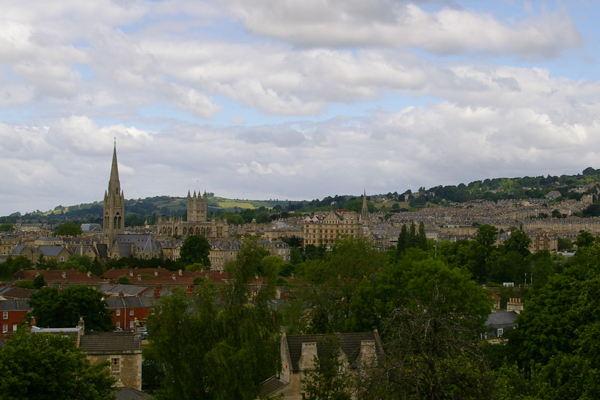 |
I chose our Bath B&B accommodation based on its promise of being within walking distance of the train station. True. Up a steep hill. Dragging our luggage. In the rain. Nevertheless Oldfields House was a great place in a good location with views over the city. The best part was a book with various walking tours. That alone was worth the wet slog. |
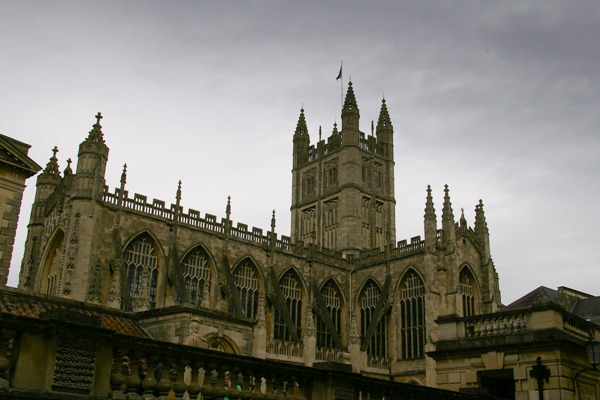 |
On a different trip to the UK, the leaders explained that the English designation of "city" is predicated on the presence of a cathedral. No cathedral = no city. From the 8th to the 13th century, the bishopric bounced between Bath and Wells before finally settling in Wells. When this church was a cathedral, Bath was a city. Now the church is attached to an abbey and no longer the seat of the bishop, yet Bath is still a city. How? By "ancient prescriptive right." See an exhaustive/exhausting discussion in Wikipedia for details. |
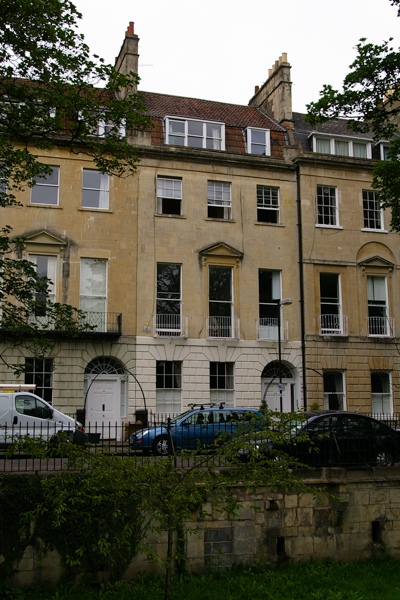 |
Using the walking tour book from our B&B as our guide, we dedicated part of a day to Jane Austen. Our first stop was #4 Sydney Place. The Austen family lived here when they first moved to Bath. Although the location seemed convenient, it was low and damp and had a bad effect on the father's health. This was our introduction to a feature of much of Bath: many streets are raised above ground level. Kitchens, coal storage, and other support functions are out-of-sight-out-of-mind whereas the family and guests enter at street level. The street is raised above the level of the park adjoining these homes. |
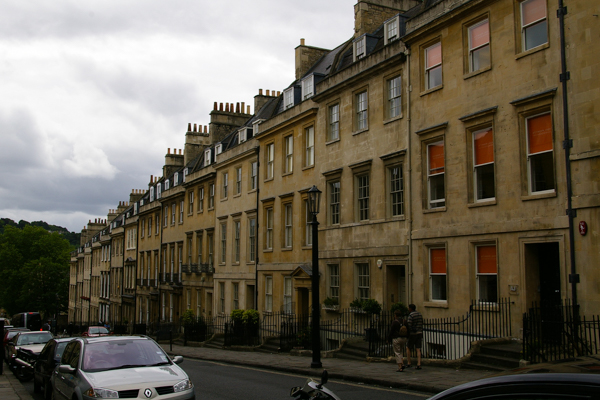 |
After Mr. Austen's death, the family – Mrs. Austen and her two unmarried daughters, Jane and Cassandra – moved to #25 Gay Street, one of this row of buildings. The family no longer had Mr. Austen's pension and this was a less expensive location. Across the street from these houses is the Jane Austen Centre. |
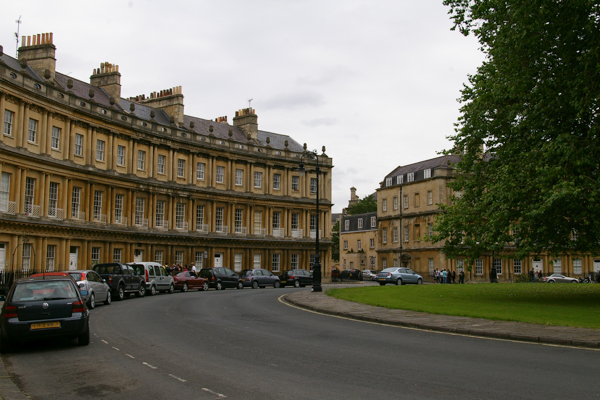 |
Jane Austen's characters were very status conscious and an address conveyed where they stood in society. The Circus was a desirable address. From the street all of these residences look the same, but in fact, there was a great variety in the size of the individual houses. The chimneys provide a clue. |
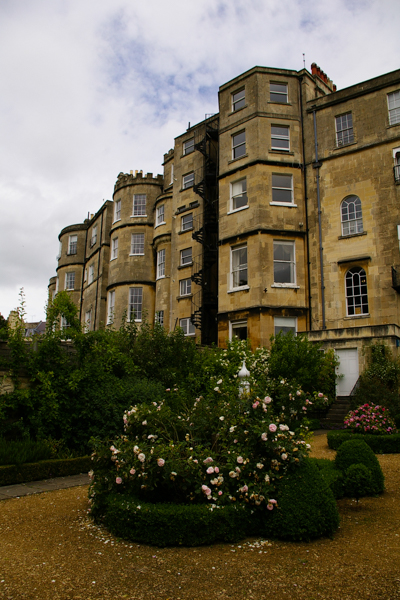 |
The rear of the houses shows little uniformity of construction. In some cases the back sides of the houses are not even finished. Here, for example, you can see an exposed spiral staircase. Our guidebook described such characteristics as "Queen Anne front and Mary Ann backside." These particular houses, which front onto the elegant Circus, are not so shabby on their backsides. Note the five levels on most of them. This contrasts with the apparent three levels on their front facades above. |
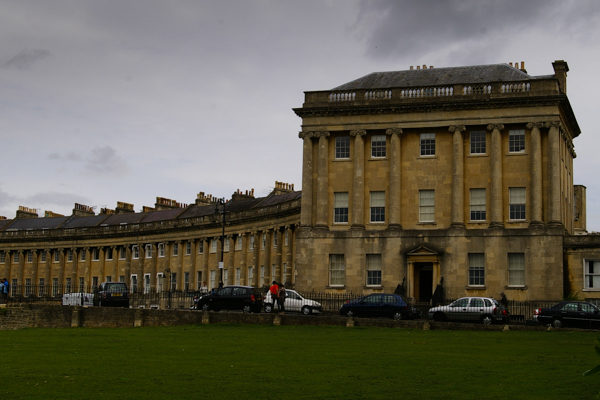 |
Not far from the Circus is the Royal Crescent – an even better address. The end building facing us is #1, a museum open to the public. A hotel comprises one or two houses. The others are still privately owned. The whole is a very impressive sight – and too large for my camera to capture. |
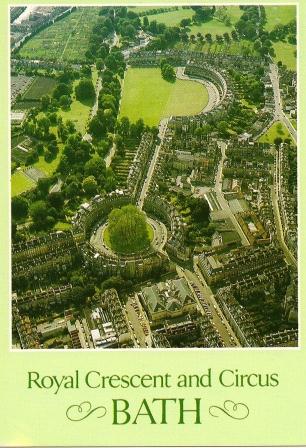 |
Not having a drone, I purchased a postcard that shows the relationship of the Circus and the Royal Crescent. Gay Street, where the Austen family lived, is the street running out of the Circus to the left, so it wasn't too shabby a neighborhood for gentlewomen in reduced circumstances. Adjacent to the Circus, in the lower center of this image, were the Assembly Rooms, another feature mentioned in Austen's novels. I was disappointed to find them closed for a private function. |
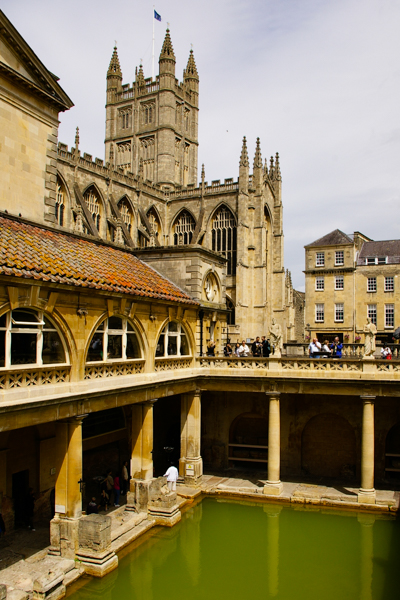 |
Balked at the Assembly Rooms, we stepped away from Austen for a bit to visit the Roman baths. Bath has been famous for its hot springs since prehistoric times, hence the name. The Romans developed the area and it has been a resort ever since. The building surrounding the pool is 18th century, but the pool and its circulating system are almost 2000 years old. The Romans were magnificent engineers and the channeling of the spring water still works well. The water may be green, but it is constantly circulated and not stagnant. The Abbey church is in the background. |
Click your "back" button to return to the previous page or click for our picture album.