On the upbound leg of our trip we passed the locks at night. Downbound we passed the Soo Locks in the early morning.
I consistently awoke around 6am, so I watched the approach and transit.
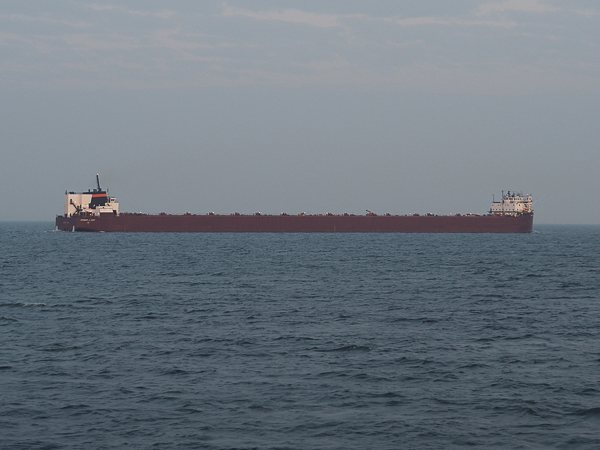
As we entered Whitefish Bay on our approach to the locks, we started to see more ships. We had been surprised by the paucity of ship sitings, but the bulk freighters have gotten so big, that many smaller ships have been retired.
This is the Stewart J. Cort. She entered service in 1972 and holds the distinction of being the first 1000-foot carrier on the lakes. Her stern and bow sections were built in Pascagoula, Mississippi, and joined together for the trip to the lakes. In that initial configuration she was only 182 feet long and had the nickname "Stubby" as she traveled north. There was a painted line where the two sections were joined along with the notation "cut on dotted line."
Her midbody was built in Erie, Pennsylvania, and her pieces assembled there. She is the only 1000-footer with her pilot house and crew accommodations in the bow (to the right in this image).
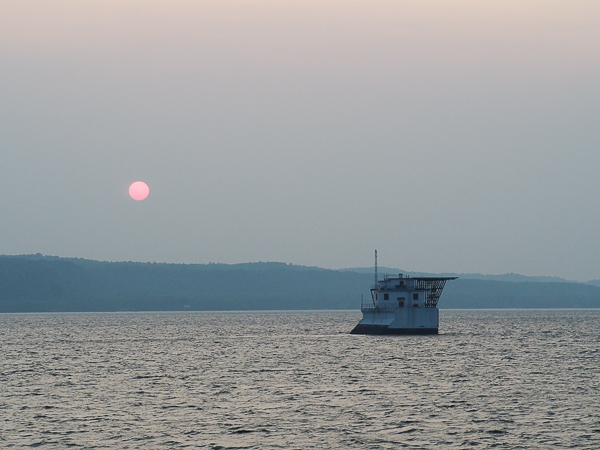
This peculiar structure is the Gros Cap Reef Light.
Gros Cap Reef lies at the entrance of the St. Marys River from Whitefish Bay. The location was first marked by a buoy, then in 1923 by a lightship. The lighthouse was completed in 1953. The curious structure on top is a helipad. The light was automated in the 1980s.
One of the web sites I found suggests that the structure be turned into a B&B! I'll pass.
The spooky sun indicates that the forest fire smoke has followed us east. We were lucky that we never had the worst of it, but it was bad enough.
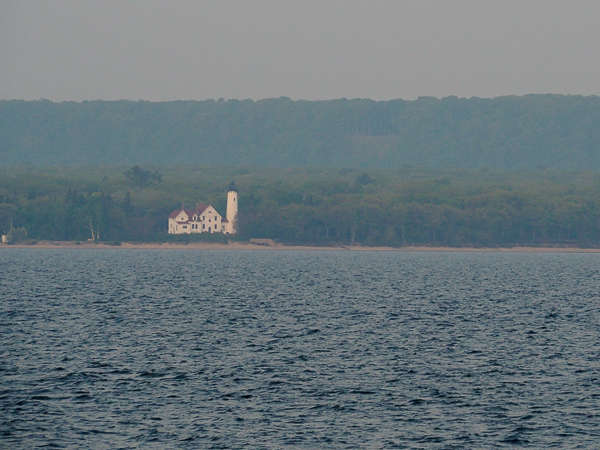
The Point Iroquois Light in Michigan marks the entry into the St. Marys River from the American side.
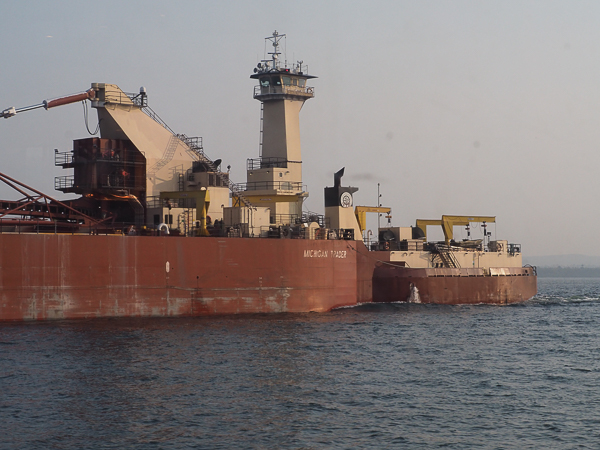
The Michigan Trader is a bulk carrier barge, not a ship. The tug Dirk S. VanEnkevort provides the propulsion.
This combination is called an articulated barge. (The discussion at the link gets technical, but it includes a fascinating description of how the tug was created from a cut-down freighter.) The two units work as one. The concept evolved from the Mississippi barge tows of a raft of barges with one tug. Check this web site for historical information and speculation of how similar articulated vessels might be used in ocean contexts.
Recycling is alive and well in Great Lakes shipping.
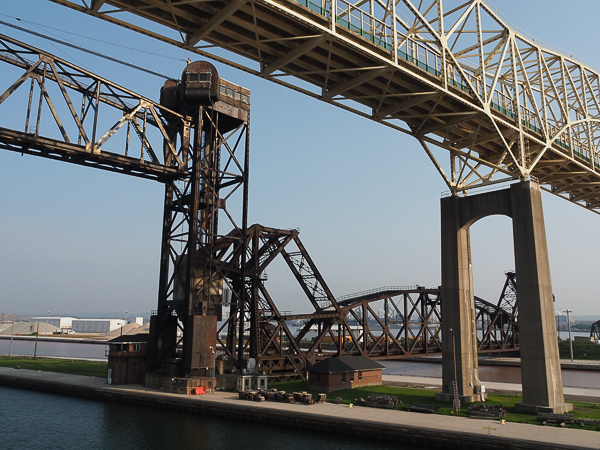
As we enter the locks, our ship passes under the International Railroad Bridge and the International Bridge (the lighter colored one). The RR bridge was built in 1887.
According to Gray & Pape Heritage Management Company, the Sault Ste. Marie International Railroad Bridge has nine camelback truss spans crossing the St. Mary’s River along with bascule and vertical lift bridge components crossing the American Locks at the St. Mary’s Falls Canal. It is the only bridge in the United States known to include these three types of spans in a single structure. In addition, the bridge was the first structure to use an interlocking mechanism to connect the leaves of the double-leaf bascule span. "The International Railroad Bridge represents a nationally significant engineering structure and is Michigan’s most significant railroad bridge from an engineering history standpoint."
More interesting details can be found at HistoricBridges.org.
The vertical lift bridge on the left is raised to let us through. The bascule bridge is on the right.
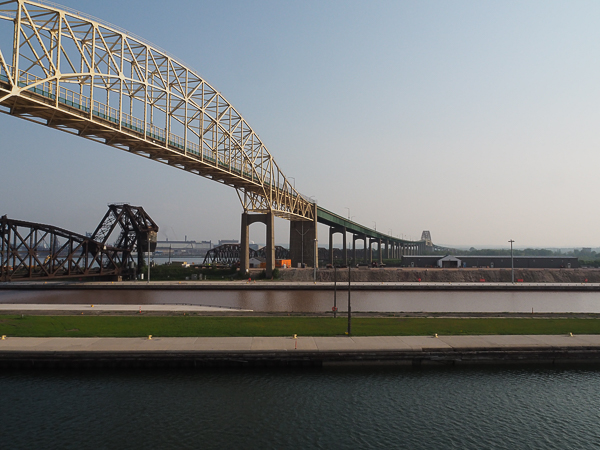
The International highway bridge was opened in 1962. The next closest land crossing between the US and Canada is about 700 miles away.
In order to re-enter the US from Canada after passing the locks, we had to be bused from the ship to the Michigan border crossing located at the toll plaza on this bridge. Immigration authorities accompanied each bus. The Canadian customs people in Thunder Bay came on board the ship and made the crossing into Canada easy-peasy. It was not so simple here, and it reminded us of border crossings in Central Asia.

The Poe and MacArthur locks are on the American side. There is also a smaller lock on the Canadian side used mostly for pleasure craft. The Poe lock accommodates large lakers and there is a need for an additional large lock, which is currently under construction. Continuing funds to complete the work are in jeopardy under the Trump administration, so its status is uncertain.
Our ship will be locking down in the smaller MacArthur lock on the right. At the same time, the 1000-footer Edgar B. Speer is locking up in the adjacent Poe lock. Like so many of the other ships we saw, it was cobbled together with pieces built here & there. It entered service in 1980.
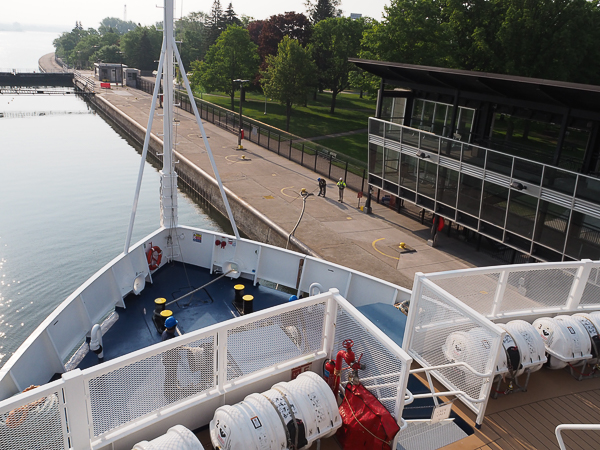
The building to the right of the lock is an observation deck belonging to the Soo Locks Visitor Center. At the time of our passage there was no one there, but later in the day when we came back, it was crowded with people watching the ships pass.
On this side of the lock gates, a boom arm can be seen crossing the lock. This is part of a ship arrestor system. A boom raised and lowered by that arm is capable of stopping a drifting ship to protect the lock gates. In 2023 a crack was discovered in one of the components of the system. The Corps of Engineers made history by producing a replacement part in 12 weeks rather than the typical 18 months by using 3D printing.
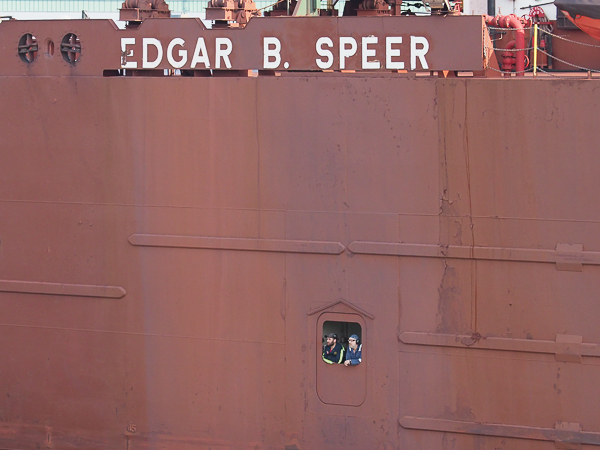
Crewmen on the Edgar B. Speer are rubbernecking through the lock same as us tourists. Or maybe they were rubbernecking at our ship the same as we were rubbernecking at theirs.
I exchanged waves with workers topside on the laker.
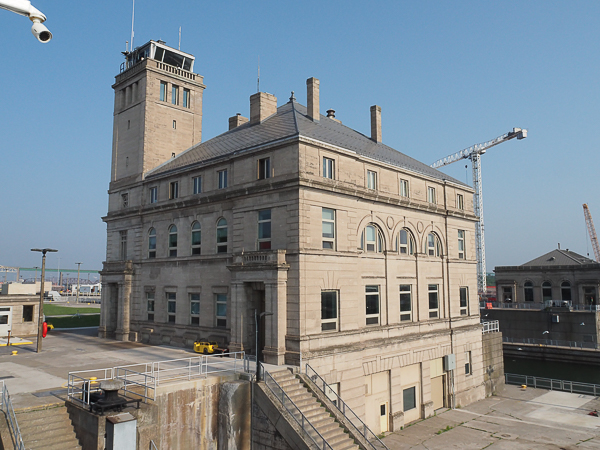
I have been unable to find anything about the control tower and administration building located between the locks.
Below the locks we docked at a pier where we could meet our buses for clearing customs and visiting downtown Sault Ste. Marie.
Click your "back" button to return to the previous page or click for our picture album.